Sunday, November 22, 2020

Friday, February 22, 2019
Monday, November 26, 2018
Review Essay of Melinda Cooper's book Family Values (Cultural Studies)
REVIEW ESSAY
Released on line from Cultural Studies at https://doi.org/10.1080/09502386.2018.1546333
Public policy case studies in reactionary politics: why US Cultural Studies needs political economy
Family values: between neoliberalism and the new social conservatism, by Melinda Cooper, New York, Zone Books, 2017, 416 pp., $29.95 (hardcover), ISBN 9781935408840
Melinda Cooper’s Family Values could be a wake up call to Cultural Studies as it has been practiced in the United States since the mid-1990s. In this book Cooper offers a descriptive critique of how US liberal democracy was consciously reconfigured by reactionary public policy politics and legislation, generating a national culture that has lurched into the current narrowing miasma of concentrated, anti-liberal political economy. In her detailed exploration of the ways US culture took its lengthy right-wing political turn over 45 years, Cooper describes the ‘reinstitutionalization’ (p. 295) of structures that had been incorrectly assumed by liberals and progressives to be the fabric of US life. In detailing this shift in culture, Cultural Studies receives not a mention, while the field of culture itself is barely explicitly elaborated, with the exception of one reference to ‘culture wars’ (p. 22). This suggests a major discontinuation between the operational spaces of US public policy and US Cultural Studies.
Cooper explores public policy through the lens-making machinery of The State and non-state actors such as think tanks and public intellectuals (including Milton Friedman and Gary Becker). In doing this, she connects the less known aspects of post-Fordism with the rise of family responsibility within the intersection of economics and evangelical fundamentalism. She highlights an intentional intersectionality on the part of activist conservatives that combined into what can be described as post-Fordist family fundamentalism. This intersection was promoted, as Cooper highlights, alongside charity as part of an anti-welfare, anti-statist conservatism: all aimed at generating neo-liberal hegemony as the only alternative to a welfare-based model of liberal democracy. Meanwhile, against this focus of Cooper’s, US Cultural Studies appears to have been disabled by a misdirected disarticulationofculturefrompublicpolicyandmorespecificallypoliticaleconomy,a concern to which I will return later in this review. In Family Values the intersection of political economy with public policy making is writ large–often in ways that are shocking, as Cooper’s research shows the programmatic focus of liberal and conservative, neo-liberal and neo-conservative intellectuals in actively unmaking an open and tolerant liberal-progressive US society.
Unfortunately,Cooper’s book shows evidence of little effective resistance,even when it took on the form of dedicated opposition. The notable victorious exception being the AIDS Coalition to Unleash Power (ACTUP) response to the US Government’s refusal to take public health action during the AIDS crisis in the 1980s. And while there is little to be gained in raking over the ashes of many policy defeats, the evidence Cooper presents for the success of neo-liberalism and the right in general makes it clear how a well-orchestrated ideological program simply rolled over progressive goals with reactionary public policy orchestrations.
Indeed, the systematic undoing of Roosevelt’s New Deal and Johnson’s Great Society policies is the core around which the book revolves, identifying the alliances – now well known – between a few determined thinkers whose astuteness was not so much in their ideas, but in how they waited until all the political pieces were in place to enact their claims on ‘freedom.’
The question, of course, is how freedom is constituted. Cooper argues that in its US meaning,it has been reconstructed through policies that forced the enactment of the private family as the centerpiece of the intellectual, social, economic and cultural world. In fact, every avenue of human activity was the target of the philosophical adventure the right set upon, remaking the imagination around a sanctified nucleated family responsible entirely for its own welfare and continuance. Using emotional, traditional and religious language in association with claims for emancipation and in favor of a cruelty they would not name, they constructed an affective structure.
Against this program, nobody offered much opposition to centralizing the family as the moral and economic unit of existence. In detailing the policy shifts that ‘sought to revive the traditions of private responsibility’ (p. 22), Cooper connects reactionary ideology with sentimental soft-headedness and nostalgia, best exemplified in the California Governorship and then the Presidency of Ronald Reagan. Centralizing the family meant pulling away the humanizing systems of public support that liberals and progressives had built, redirecting the preferred energy of society into an individualism championed most notably by Rose and Milton Friedman. These two, along with Gary Becker and Daniel Patrick Moynihan, innovated a public policy deconstruction program that stretched from the 1960s, interweaving market-focused economic studies with sexuality, family life, religion, and a moralistic public policy belligerence that consulted few citizens, and when pressed called on the mythologizing images of invented tradition. As a concept, it is well deployed by Cooper, drawing on the English historian Eric Hobsbawm’s The Invention of Tradition, to illustrate how most social life is the result of socially constructed ideas translated into the dominant ideology of everyday culture, as Althusser showed the world in his explanation of the Institutional State Apparatus (ISA).
All of this US backwardness was enhanced by a self-satisfied belief in American exceptionalism, a kind of precursor to the current situation, in which the America First of MAGA (Make America Great Again) calls on a culture based on the imaginary of religious faith embedded in economic rules that drive everyone – and I mean everyone – away from collective interests (unless its sport and maybe party politics) to the bosom of the family. As such, Cooper argues in a welcome application of Michel Foucault, that ‘moral exclusion zones’ were established by conservative elites to police, discipline, control and suppress public life, and the sense that liberality could be normalized.
For Cooper, almost no recent US political figure escapes opprobrium for their role in the de-liberalization of American life. In doing so, her historiography draws on political economy’s critical traditions, meaning a historical materialism informed by Marxism and institutional sociology focused on the interface of policy documents and intellectual history. Importantly, she documents negative social movements – in these cases, a strategic program of interlinked activities aimed at winding back progressive liberalism.
Her approach explores the development of the neo-conservative movement in its articulation with the capitalist preference for a kind of liberalism that is all encompassing and affective; promising ‘freedom’ within the fantasy of US democracy, yet really operating under increasing constraints managed by ‘older and wiser’ white homo-economicus males. Frankly, I would suggest that academics on the right have studied and used affect much more effectively and efficiently than those on the left, because their affective cause is pre-defined by their daily experience and success with marketing propaganda. Their magic potion has been in orchestrating affect within capitalism alone. Conservatives, especially Republicans, have manipulated public discourse for most Americans, socializing the population into the uncontested belief that the business way of life alone is supreme and totally normal.
Around this converged field of relentless yet limiting affect, conservatives built their family focus, exemplified by the Focus on the Family organization, the conservative activist group that used media to paint pictures of the worthy domestic Christian life. Closely drawing the line around economics and individual responsibility within the family, the conservative movement corralled the moral universe of neo-liberalism and neoconservatism within a reconstituted affect that Lauren Berlant somewhat tepidly referred to in Cruel Optimism (2011) as ‘the fraying relation between post-Second World War state/economic practices and certain postwar fantasies of the good life’ (p. 15). Cooper makes it clear that the disarticulation between the good life and the welfare state in the US was much more than fraying; it was the systematic cauterizing of liberal and progressive public policy combined with a succession of successful negative social movements.
Conservatives achieved this through the missing ingredient in this book – media control that operated as public propaganda. All the policy documents marrying Milton Friedman’s histrionics with neoconservatism would have been far less successful if liberal, progressive and left opponents had understood and effectively utilized the media as a countervailing force. They didn’t, despite protestations from conservatives about ‘liberal Hollywood,’ while the likes of William F. Buckley and Ronald Reagan made multiple appearance on television, speaking directly to the domestic family to reinforce the righteousness of the inward looking, horizon shrinking, unit of economic self-management.
Despite this criticism, Cooper shows how reactionaries went about politicizing religion while building their anti-welfare, pro-family ideology. Her take on Fordism and its undoing draws the startling cruel connection between the enactment of the white male as head of the nuclear household and breadwinner, against black people and their culture:
Clearly, there is no point in being nostalgic for Fordism! In addition, she makes it clear that black attitudes to sexuality, the family and marriage were disciplined in ways that robbed them (again) of the dignity of their culture, forcing them into economic independence, remade as a Christian virtue, as the welfare system was undone – most notably by President Bill Clinton. This kind of program was foregrounded on an understanding of English poor laws, with claims that they offered state sustenance for the unworthy, while those same laws insisted on criminalizing unmarried sex. President Clinton seemed to do all he could to continue the momentum of reducing welfare and privileging responsible family life with home ownership. All the while boosting a type of neoliberal capitalism as the solution white males proposed against unwieldy black women who took welfare while having children devoid of present fathers.
Furthermore, Cooper shows how inherited wealth was repositioned within the ideological frame of entitlements for the already white deserving majority, in ‘the reassertion of the private family as a critical economic institution and a portal to social legitimacy’(p.123). Nexus after nexus,block after block, the pieces were put together in public policy white papers and think tanks, then translated into legislation, while the numbers of people attending churches that promoted the prosperity gospel grew (especially more recently), providing the well-manicured psychic short-circuiting of a culture in which these days many millions of Americans rejoice with Donald Trump’s every word.
The selection of case study documents in Family Values shows how public policy found sustenance from leading intellectuals on the right. This is particularly startling in the chapter about the AIDS crisis where Cooper exposes the reader to some of the least worthy moral assertions made by otherwise rational agents. Especially startling is her description of the contributions made by Judge Richard Posner, who argued that AIDS was the result of promiscuity and that the state should minimize social insurance and regulate public health in favor of ‘promoting marriage’(p.173).For homosexual people, this approach merely added to the dominating, suffocating heteronormative culture they had already rejected.
Heteronormativity was and remains deeply embedded in mainstream US culture; a point Cooper somewhat skips over. For example, artist and activist David Wojnarowicz, who died in 1992 at age 37 from AIDS, was barred from an exhibition for being too political, prompting him to write: ‘I’m in the throes of facing my own mortality and in attempting to communicate what I’m expressing or learning in order to try and help others, I am effectively silenced. I am angry.’ (Andrea K. Scott, The New Yorker, May 21, 2018, p. 14). His comment suggests deep public aversion to homosexuality before it was legalized in the US. Furthermore, his comments suggest that the detailed policy research informing Family Values could be seen to lose site of the public culture in which reactionary movements are grounded: for example, the 30 percent of the US population who currently support Donald Trump’s Presidency.
The point, of course, is that the building blocks of an ideal private household were constructed around the liberated white heterosexual couple whose goal was self-managed wealth creation. And Cooper makes this point with a steadily evolving body of evidence, identifying how an incorporationist political economy moved across the spectrum of social and cultural life to remake US liberalism, as much through the ‘reinstitutionalization of religion’ (p. 295) as through ‘structural charity’ (p. 301) based on Christian prison reform and traditional home making.
Chapters in Family Values on student debt and faith-based welfare explain how the shifts in attitude and public policy were opportunistically built by capitalist interests after recessions and economic crises. The ‘reforms’ that followed economic and financial crises aimed at further reducing state support systems, nailing home the critical success factors of neoconservatism, while pointing to the political skill with which the movement consistently operated a double movement advanced by the historical sociologist Karl Polanyi: privileging familial virtue while simultaneously economizing that virtue as it was moved by public policy changes outside the purview of state responsibility. Consequently, neoliberalism in its association with neoconservatism became the coherent overarching system, as Jason Read defined it in ‘A Genealogy of Homo-Economicus: Neoliberalism and the Production of Subjectivity’:
Hopefully, the claim that human nature is equated with neo-liberalism will be short lived, given how persuasively Cooper has shown that it is human agency that has been active in creating the current perversions of the culture of cruelty. After all, Social Darwinism is nothing but an invention, and a terrifying one at that. Cooper shows how, given Read’s definition of neo-liberalism, the negative social movements that consolidated around neoconservatism’s political economy have truncated thinking to an extent that gay marriage is considered a major victory in the struggle for that community’s emancipation. Such is the ideological success of the political re-enculturation program in the US, that other ways of living outside traditional marriage within the model of the heteronormative family escape the social imaginary.
All of which begs the question,what happened to Cultural Studies in this story? The answer, I suggest, is to be found in the rupture advanced by Larry Grossberg in his 1995 article ‘Cultural Studies vs Political Economy: Is Anybody Else Bored with this Debate?’ published in Critical Studies in Mass Communication. Grossberg took aim at the English policy researcher and Marxist Nicholas Garnham, who had insisted on the somewhat traditional, perhaps even reductionist, connection between political economy and culture, to which Grossberg objected on the grounds that ‘cultural studies and political economy…have always been divided over the terms of an adequate theory of culture and power’ (p. 72) and furthermore that Cultural Studies was unique in the way it proffered new critical insights about the interactions between economics and society. In hindsight, Grossberg’s priority was a bold, boundary-setting effort to corral Cultural Studies within the horizon of the United States imagination, cutting off political economy from an enriching exchange.
This disconnect between culture and political economy has been noticeable in the US approach to Cultural Studies largely because the lines of demarcation within the academy have been fiercely drawn in keeping with professional territoriality. As Cultural Studies established itself in the US academy, it isolated itself from interdisciplinary alliances that were necessary for its transformation into a mature academic field. Where US Cultural Studies could have been digging into the corners of public policy making, to engage with the political structures of The State, it generally did not: there was no Cultural Policy Studies moment in the US for this reason, unlike those formations in Australia in the mid-1990s, Western Europe or South America. And unfortunately, the isolation of US Cultural Studies took place within the context of systematic programs of regressive public policy making, leaving Cultural Studies insufficiently capable of resisting the reactionary political economy and its culture. It is this disconnect that Melinda Cooper’s Family Values explores, without explicitly naming the disarticulation and subsequent failure to engage at the nexus of political economy and public policy making that characterizes US Cultural Studies.
Indeed, Cooper’s book helps understand the implications that flowed from cutting the trajectory of Cultural Studies from how it was imagined by Raymond Williams, as a complex relationship between the structures of power and those of feeling. As Williams noted in the posthumous collection Resources of Hope, cited by Geoff Dyer in the Introduction to Political Studies and Letters: Interviews with New Left Review: ‘I learned the reality of hegemony, I learned the saturating power of the structures of feeling of a given society, as much from my own mind and my own experience as from observing the lives of others. All through our lives, if we make the effort, we uncover layers of this kind of alien formation in ourselves, and deep in ourselves’ (p. ix). At a slightly different register from the personal, political economy became the alien formation that was prematurely objected to by Grossberg, prioritizing US Cultural Studies around feeling, affect and power while generally evacuating the structural connections to public policy and political economy. This is not to suggest that Grossberg dismissed economics and public policy making entirely. For example, in 1998 Anne Balsamo arranged a workshop forum in Atlanta about Cultural Studies and economics, led by Balsamo and Grossberg and attended by a small cohort of interested colleagues, including Will Straw and myself. But the event did not assuage my concerns that aggressively pushing away political economy denied US Cultural Studies the capacity to comprehend the alien formations in the US structures of everyday life, in something like the framework envisioned by Williams, and informed by critical research undertaken by Cooper.
Despite such limitations, Cultural Studies has been ensconced, albeit precariously, in US universities after achieving its institutionalization: an achievement that Williams suggested would be the measure of its success. Unfortunately, he did not have US culture in mind when he invoked this kind of aspiration for Cultural Studies. If Williams had known more about the way professional boundary riding takes place in universities within US liberal democracy, especially given the disciplinary strictures of Protestant hegemonic culture, his aspirations may have been more circumspect. (Thanks to Kathryn Montalbano for introducing me to this phrase). This is to say Cultural Studies in the US academy has been incorporated into the system of management and tenure that is unique to US university life. It is a system that relies on professional claims by tenured academics to make and maintain the boundaries of their ‘discipline,’ often in ways that are counterproductive to the interdisciplinary capacity of critical knowledge production, especially in a field such as Cultural Studies.
Nevertheless, many years later, Cultural Studies is predictably fragmented. In some cases, this resulted from the way political economy hived off into Cultural Policy Studies and more recently into the neo-positivist backwaters of Cultural and Media Economic Studies, areas of research whose liberal economistic fetishizations are mostly a world away from the critical engagement that excited many of us when Cultural Policy Studies emerged. In effect, after the breech with political economy, US Cultural Studies was effectively emasculated as a force for public policy research through informed debate around political economy. These ruptures, breaks, realignments and redirections ran alongside an academic professionalizing impulse to discipline the field, and in so doing, refuse engagements with what became the alien formations of public policy making and political economy. Cultural Studies, in the United States especially, has been the poorer for it.
As an academic enterprise, the focus of Cultural Studies was and is outstanding academic work, much of which was and is exemplary – as academic work. Within this formation, another identifiable limitation of US Cultural Studies is the stymied logic of its connection with social movements, motivated as they are by political economic grievances. Articulating social movement research to political economy and public policy engagement within US Cultural Studies is a black hole, as the absence of this connection in Cooper’s book also indicates. Perhaps Grossberg was on to something after all, when he forced the rupture with political economy? In other words, in the US there were and are too few avenues available for academics to bring Cultural Studies into public policy making through a direct connection with political economy and social movements because the segmentation of the society is bounded, while the politics is parochial and territorial–as one of the most insurgent Cultural Policy Studies mavens Colin Mercer often noted before his untimely death in 2013.
As someone uniquely experienced in Australian, US and global public policy analysis and political economy, I am the first to acknowledge that the difference between doing Cultural Studies in the US and doing it in Australia and Europe is as different as Wales was to Cambridge University for Raymond Williams, or Princeton University was to Toni Morrison’s childhood in Ohio. Nevertheless in Australia and Europe, it has been possible to engage in public policy making informed by political economy and Cultural Studies – while in the US, the boundaries bar entry to anyone not moving through the ‘proper’ circles, also known as revolving doors.
These missing articulations mean that US Cultural Studies has a great deal of catching up to do, reconnecting its focus on culture with political economy and public policy making. Or to put it in a somewhat more literary form, it needs to articulate, as Williams term above suggested, the alien formations of political economy, public policy making and social movements with the core of the project, while simultaneously embodying the other meaning of articulation: Cultural Studies needs to generate a public maneuver with which to speak about the ideological forces that determine the structures of life. To return to Williams, writing in ‘Base, Superstructure in Marxist Cultural Theory,’ the pressing necessity of cultural research is in identifying the workings of determinism, as forces of ‘prefiguration, prediction and control.’ Of course, this may be precisely what the disarticulation of Cultural Studies from political economy was about–apost-structuralist move away from the determining economic structures of the base and therefore not creating, as Louis Althusser suggested, the continents of theory required to critique and overthrow the ISAs on the path to socialism.
Unfortunately, Cultural Studies seems to have had little to offer when confronted with the application of neoliberalism and its neo-conservative foundations in the US. Certainly, it has tried to develop a critique, and in some cases in which it has established a presence in the academy, it has succeeded, but the success of the neo-conservative and reactionary movements has meant that US culture has changed. If it is possible to say ‘thankfully’ in these parlous days, then thankfully some alternatives have managed to succeed. One such alternative is the continuation of Cultural Studies as an academic enterprise, along with some environmental activism and LGBTQ+ liberation and ACTUP, even though as Cooper shows, the success is deeply qualified, even circumscribed by the boundaries set by neo-liberalism. One productive option would be to consistently act at the intersection of Cultural Studies and its alliances with political economy and social movement theory, in a commitment to stop the programmatic invention of unliberal traditions in an increasingly cruel United States.
Marcus Breen
Communication Department, Boston College, 350 St Mary’s Hall South, 140 Commonwealth Avenue, Chestnut Hill, MA, USA 02469 breenmk@bc.edu
http://orcid.org/0000-0002-1917-4356
© 2018 Marcus Breen
https://doi.org/10.1080/09502386.2018.1546333
Released on line from Cultural Studies at https://doi.org/10.1080/09502386.2018.1546333
Public policy case studies in reactionary politics: why US Cultural Studies needs political economy
Family values: between neoliberalism and the new social conservatism, by Melinda Cooper, New York, Zone Books, 2017, 416 pp., $29.95 (hardcover), ISBN 9781935408840
Melinda Cooper’s Family Values could be a wake up call to Cultural Studies as it has been practiced in the United States since the mid-1990s. In this book Cooper offers a descriptive critique of how US liberal democracy was consciously reconfigured by reactionary public policy politics and legislation, generating a national culture that has lurched into the current narrowing miasma of concentrated, anti-liberal political economy. In her detailed exploration of the ways US culture took its lengthy right-wing political turn over 45 years, Cooper describes the ‘reinstitutionalization’ (p. 295) of structures that had been incorrectly assumed by liberals and progressives to be the fabric of US life. In detailing this shift in culture, Cultural Studies receives not a mention, while the field of culture itself is barely explicitly elaborated, with the exception of one reference to ‘culture wars’ (p. 22). This suggests a major discontinuation between the operational spaces of US public policy and US Cultural Studies.
Cooper explores public policy through the lens-making machinery of The State and non-state actors such as think tanks and public intellectuals (including Milton Friedman and Gary Becker). In doing this, she connects the less known aspects of post-Fordism with the rise of family responsibility within the intersection of economics and evangelical fundamentalism. She highlights an intentional intersectionality on the part of activist conservatives that combined into what can be described as post-Fordist family fundamentalism. This intersection was promoted, as Cooper highlights, alongside charity as part of an anti-welfare, anti-statist conservatism: all aimed at generating neo-liberal hegemony as the only alternative to a welfare-based model of liberal democracy. Meanwhile, against this focus of Cooper’s, US Cultural Studies appears to have been disabled by a misdirected disarticulationofculturefrompublicpolicyandmorespecificallypoliticaleconomy,a concern to which I will return later in this review. In Family Values the intersection of political economy with public policy making is writ large–often in ways that are shocking, as Cooper’s research shows the programmatic focus of liberal and conservative, neo-liberal and neo-conservative intellectuals in actively unmaking an open and tolerant liberal-progressive US society.
Unfortunately,Cooper’s book shows evidence of little effective resistance,even when it took on the form of dedicated opposition. The notable victorious exception being the AIDS Coalition to Unleash Power (ACTUP) response to the US Government’s refusal to take public health action during the AIDS crisis in the 1980s. And while there is little to be gained in raking over the ashes of many policy defeats, the evidence Cooper presents for the success of neo-liberalism and the right in general makes it clear how a well-orchestrated ideological program simply rolled over progressive goals with reactionary public policy orchestrations.
Indeed, the systematic undoing of Roosevelt’s New Deal and Johnson’s Great Society policies is the core around which the book revolves, identifying the alliances – now well known – between a few determined thinkers whose astuteness was not so much in their ideas, but in how they waited until all the political pieces were in place to enact their claims on ‘freedom.’
The question, of course, is how freedom is constituted. Cooper argues that in its US meaning,it has been reconstructed through policies that forced the enactment of the private family as the centerpiece of the intellectual, social, economic and cultural world. In fact, every avenue of human activity was the target of the philosophical adventure the right set upon, remaking the imagination around a sanctified nucleated family responsible entirely for its own welfare and continuance. Using emotional, traditional and religious language in association with claims for emancipation and in favor of a cruelty they would not name, they constructed an affective structure.
Against this program, nobody offered much opposition to centralizing the family as the moral and economic unit of existence. In detailing the policy shifts that ‘sought to revive the traditions of private responsibility’ (p. 22), Cooper connects reactionary ideology with sentimental soft-headedness and nostalgia, best exemplified in the California Governorship and then the Presidency of Ronald Reagan. Centralizing the family meant pulling away the humanizing systems of public support that liberals and progressives had built, redirecting the preferred energy of society into an individualism championed most notably by Rose and Milton Friedman. These two, along with Gary Becker and Daniel Patrick Moynihan, innovated a public policy deconstruction program that stretched from the 1960s, interweaving market-focused economic studies with sexuality, family life, religion, and a moralistic public policy belligerence that consulted few citizens, and when pressed called on the mythologizing images of invented tradition. As a concept, it is well deployed by Cooper, drawing on the English historian Eric Hobsbawm’s The Invention of Tradition, to illustrate how most social life is the result of socially constructed ideas translated into the dominant ideology of everyday culture, as Althusser showed the world in his explanation of the Institutional State Apparatus (ISA).
All of this US backwardness was enhanced by a self-satisfied belief in American exceptionalism, a kind of precursor to the current situation, in which the America First of MAGA (Make America Great Again) calls on a culture based on the imaginary of religious faith embedded in economic rules that drive everyone – and I mean everyone – away from collective interests (unless its sport and maybe party politics) to the bosom of the family. As such, Cooper argues in a welcome application of Michel Foucault, that ‘moral exclusion zones’ were established by conservative elites to police, discipline, control and suppress public life, and the sense that liberality could be normalized.
For Cooper, almost no recent US political figure escapes opprobrium for their role in the de-liberalization of American life. In doing so, her historiography draws on political economy’s critical traditions, meaning a historical materialism informed by Marxism and institutional sociology focused on the interface of policy documents and intellectual history. Importantly, she documents negative social movements – in these cases, a strategic program of interlinked activities aimed at winding back progressive liberalism.
Her approach explores the development of the neo-conservative movement in its articulation with the capitalist preference for a kind of liberalism that is all encompassing and affective; promising ‘freedom’ within the fantasy of US democracy, yet really operating under increasing constraints managed by ‘older and wiser’ white homo-economicus males. Frankly, I would suggest that academics on the right have studied and used affect much more effectively and efficiently than those on the left, because their affective cause is pre-defined by their daily experience and success with marketing propaganda. Their magic potion has been in orchestrating affect within capitalism alone. Conservatives, especially Republicans, have manipulated public discourse for most Americans, socializing the population into the uncontested belief that the business way of life alone is supreme and totally normal.
Around this converged field of relentless yet limiting affect, conservatives built their family focus, exemplified by the Focus on the Family organization, the conservative activist group that used media to paint pictures of the worthy domestic Christian life. Closely drawing the line around economics and individual responsibility within the family, the conservative movement corralled the moral universe of neo-liberalism and neoconservatism within a reconstituted affect that Lauren Berlant somewhat tepidly referred to in Cruel Optimism (2011) as ‘the fraying relation between post-Second World War state/economic practices and certain postwar fantasies of the good life’ (p. 15). Cooper makes it clear that the disarticulation between the good life and the welfare state in the US was much more than fraying; it was the systematic cauterizing of liberal and progressive public policy combined with a succession of successful negative social movements.
Conservatives achieved this through the missing ingredient in this book – media control that operated as public propaganda. All the policy documents marrying Milton Friedman’s histrionics with neoconservatism would have been far less successful if liberal, progressive and left opponents had understood and effectively utilized the media as a countervailing force. They didn’t, despite protestations from conservatives about ‘liberal Hollywood,’ while the likes of William F. Buckley and Ronald Reagan made multiple appearance on television, speaking directly to the domestic family to reinforce the righteousness of the inward looking, horizon shrinking, unit of economic self-management.
Despite this criticism, Cooper shows how reactionaries went about politicizing religion while building their anti-welfare, pro-family ideology. Her take on Fordism and its undoing draws the startling cruel connection between the enactment of the white male as head of the nuclear household and breadwinner, against black people and their culture:
the Fordist family wage not only functioned as a mechanism for the normalization of gender and sexual relationships, but it also stood at the heart of the midcentury organization of labor, race, and class, defining African American men by their exclusion from the male breadwinner wage and African American women by their delegation to agricultural and domestic labor in the service of white households. (p. 8)
Clearly, there is no point in being nostalgic for Fordism! In addition, she makes it clear that black attitudes to sexuality, the family and marriage were disciplined in ways that robbed them (again) of the dignity of their culture, forcing them into economic independence, remade as a Christian virtue, as the welfare system was undone – most notably by President Bill Clinton. This kind of program was foregrounded on an understanding of English poor laws, with claims that they offered state sustenance for the unworthy, while those same laws insisted on criminalizing unmarried sex. President Clinton seemed to do all he could to continue the momentum of reducing welfare and privileging responsible family life with home ownership. All the while boosting a type of neoliberal capitalism as the solution white males proposed against unwieldy black women who took welfare while having children devoid of present fathers.
Furthermore, Cooper shows how inherited wealth was repositioned within the ideological frame of entitlements for the already white deserving majority, in ‘the reassertion of the private family as a critical economic institution and a portal to social legitimacy’(p.123). Nexus after nexus,block after block, the pieces were put together in public policy white papers and think tanks, then translated into legislation, while the numbers of people attending churches that promoted the prosperity gospel grew (especially more recently), providing the well-manicured psychic short-circuiting of a culture in which these days many millions of Americans rejoice with Donald Trump’s every word.
The selection of case study documents in Family Values shows how public policy found sustenance from leading intellectuals on the right. This is particularly startling in the chapter about the AIDS crisis where Cooper exposes the reader to some of the least worthy moral assertions made by otherwise rational agents. Especially startling is her description of the contributions made by Judge Richard Posner, who argued that AIDS was the result of promiscuity and that the state should minimize social insurance and regulate public health in favor of ‘promoting marriage’(p.173).For homosexual people, this approach merely added to the dominating, suffocating heteronormative culture they had already rejected.
Heteronormativity was and remains deeply embedded in mainstream US culture; a point Cooper somewhat skips over. For example, artist and activist David Wojnarowicz, who died in 1992 at age 37 from AIDS, was barred from an exhibition for being too political, prompting him to write: ‘I’m in the throes of facing my own mortality and in attempting to communicate what I’m expressing or learning in order to try and help others, I am effectively silenced. I am angry.’ (Andrea K. Scott, The New Yorker, May 21, 2018, p. 14). His comment suggests deep public aversion to homosexuality before it was legalized in the US. Furthermore, his comments suggest that the detailed policy research informing Family Values could be seen to lose site of the public culture in which reactionary movements are grounded: for example, the 30 percent of the US population who currently support Donald Trump’s Presidency.
The point, of course, is that the building blocks of an ideal private household were constructed around the liberated white heterosexual couple whose goal was self-managed wealth creation. And Cooper makes this point with a steadily evolving body of evidence, identifying how an incorporationist political economy moved across the spectrum of social and cultural life to remake US liberalism, as much through the ‘reinstitutionalization of religion’ (p. 295) as through ‘structural charity’ (p. 301) based on Christian prison reform and traditional home making.
Chapters in Family Values on student debt and faith-based welfare explain how the shifts in attitude and public policy were opportunistically built by capitalist interests after recessions and economic crises. The ‘reforms’ that followed economic and financial crises aimed at further reducing state support systems, nailing home the critical success factors of neoconservatism, while pointing to the political skill with which the movement consistently operated a double movement advanced by the historical sociologist Karl Polanyi: privileging familial virtue while simultaneously economizing that virtue as it was moved by public policy changes outside the purview of state responsibility. Consequently, neoliberalism in its association with neoconservatism became the coherent overarching system, as Jason Read defined it in ‘A Genealogy of Homo-Economicus: Neoliberalism and the Production of Subjectivity’:
Neoliberalism, in the texts that have critically confronted it, is generally understood as not just a new ideology, but a transformation of ideology in terms of its conditions and effects. In terms of its conditions, it is an ideology that is generated not from the state, or from a dominant class, but from the quotidian experience of buying and selling commodities from the market, which is then extended from other social spaces, ‘the marketplace of ideas,’ to become an image of society. Secondly, it is an ideology that refers not only to the political realm,to an ideal of the state,but to the entirety of human existence. It claims to present not an ideal, but a reality; human nature. (p. 25)
Hopefully, the claim that human nature is equated with neo-liberalism will be short lived, given how persuasively Cooper has shown that it is human agency that has been active in creating the current perversions of the culture of cruelty. After all, Social Darwinism is nothing but an invention, and a terrifying one at that. Cooper shows how, given Read’s definition of neo-liberalism, the negative social movements that consolidated around neoconservatism’s political economy have truncated thinking to an extent that gay marriage is considered a major victory in the struggle for that community’s emancipation. Such is the ideological success of the political re-enculturation program in the US, that other ways of living outside traditional marriage within the model of the heteronormative family escape the social imaginary.
All of which begs the question,what happened to Cultural Studies in this story? The answer, I suggest, is to be found in the rupture advanced by Larry Grossberg in his 1995 article ‘Cultural Studies vs Political Economy: Is Anybody Else Bored with this Debate?’ published in Critical Studies in Mass Communication. Grossberg took aim at the English policy researcher and Marxist Nicholas Garnham, who had insisted on the somewhat traditional, perhaps even reductionist, connection between political economy and culture, to which Grossberg objected on the grounds that ‘cultural studies and political economy…have always been divided over the terms of an adequate theory of culture and power’ (p. 72) and furthermore that Cultural Studies was unique in the way it proffered new critical insights about the interactions between economics and society. In hindsight, Grossberg’s priority was a bold, boundary-setting effort to corral Cultural Studies within the horizon of the United States imagination, cutting off political economy from an enriching exchange.
This disconnect between culture and political economy has been noticeable in the US approach to Cultural Studies largely because the lines of demarcation within the academy have been fiercely drawn in keeping with professional territoriality. As Cultural Studies established itself in the US academy, it isolated itself from interdisciplinary alliances that were necessary for its transformation into a mature academic field. Where US Cultural Studies could have been digging into the corners of public policy making, to engage with the political structures of The State, it generally did not: there was no Cultural Policy Studies moment in the US for this reason, unlike those formations in Australia in the mid-1990s, Western Europe or South America. And unfortunately, the isolation of US Cultural Studies took place within the context of systematic programs of regressive public policy making, leaving Cultural Studies insufficiently capable of resisting the reactionary political economy and its culture. It is this disconnect that Melinda Cooper’s Family Values explores, without explicitly naming the disarticulation and subsequent failure to engage at the nexus of political economy and public policy making that characterizes US Cultural Studies.
Indeed, Cooper’s book helps understand the implications that flowed from cutting the trajectory of Cultural Studies from how it was imagined by Raymond Williams, as a complex relationship between the structures of power and those of feeling. As Williams noted in the posthumous collection Resources of Hope, cited by Geoff Dyer in the Introduction to Political Studies and Letters: Interviews with New Left Review: ‘I learned the reality of hegemony, I learned the saturating power of the structures of feeling of a given society, as much from my own mind and my own experience as from observing the lives of others. All through our lives, if we make the effort, we uncover layers of this kind of alien formation in ourselves, and deep in ourselves’ (p. ix). At a slightly different register from the personal, political economy became the alien formation that was prematurely objected to by Grossberg, prioritizing US Cultural Studies around feeling, affect and power while generally evacuating the structural connections to public policy and political economy. This is not to suggest that Grossberg dismissed economics and public policy making entirely. For example, in 1998 Anne Balsamo arranged a workshop forum in Atlanta about Cultural Studies and economics, led by Balsamo and Grossberg and attended by a small cohort of interested colleagues, including Will Straw and myself. But the event did not assuage my concerns that aggressively pushing away political economy denied US Cultural Studies the capacity to comprehend the alien formations in the US structures of everyday life, in something like the framework envisioned by Williams, and informed by critical research undertaken by Cooper.
Despite such limitations, Cultural Studies has been ensconced, albeit precariously, in US universities after achieving its institutionalization: an achievement that Williams suggested would be the measure of its success. Unfortunately, he did not have US culture in mind when he invoked this kind of aspiration for Cultural Studies. If Williams had known more about the way professional boundary riding takes place in universities within US liberal democracy, especially given the disciplinary strictures of Protestant hegemonic culture, his aspirations may have been more circumspect. (Thanks to Kathryn Montalbano for introducing me to this phrase). This is to say Cultural Studies in the US academy has been incorporated into the system of management and tenure that is unique to US university life. It is a system that relies on professional claims by tenured academics to make and maintain the boundaries of their ‘discipline,’ often in ways that are counterproductive to the interdisciplinary capacity of critical knowledge production, especially in a field such as Cultural Studies.
Nevertheless, many years later, Cultural Studies is predictably fragmented. In some cases, this resulted from the way political economy hived off into Cultural Policy Studies and more recently into the neo-positivist backwaters of Cultural and Media Economic Studies, areas of research whose liberal economistic fetishizations are mostly a world away from the critical engagement that excited many of us when Cultural Policy Studies emerged. In effect, after the breech with political economy, US Cultural Studies was effectively emasculated as a force for public policy research through informed debate around political economy. These ruptures, breaks, realignments and redirections ran alongside an academic professionalizing impulse to discipline the field, and in so doing, refuse engagements with what became the alien formations of public policy making and political economy. Cultural Studies, in the United States especially, has been the poorer for it.
As an academic enterprise, the focus of Cultural Studies was and is outstanding academic work, much of which was and is exemplary – as academic work. Within this formation, another identifiable limitation of US Cultural Studies is the stymied logic of its connection with social movements, motivated as they are by political economic grievances. Articulating social movement research to political economy and public policy engagement within US Cultural Studies is a black hole, as the absence of this connection in Cooper’s book also indicates. Perhaps Grossberg was on to something after all, when he forced the rupture with political economy? In other words, in the US there were and are too few avenues available for academics to bring Cultural Studies into public policy making through a direct connection with political economy and social movements because the segmentation of the society is bounded, while the politics is parochial and territorial–as one of the most insurgent Cultural Policy Studies mavens Colin Mercer often noted before his untimely death in 2013.
As someone uniquely experienced in Australian, US and global public policy analysis and political economy, I am the first to acknowledge that the difference between doing Cultural Studies in the US and doing it in Australia and Europe is as different as Wales was to Cambridge University for Raymond Williams, or Princeton University was to Toni Morrison’s childhood in Ohio. Nevertheless in Australia and Europe, it has been possible to engage in public policy making informed by political economy and Cultural Studies – while in the US, the boundaries bar entry to anyone not moving through the ‘proper’ circles, also known as revolving doors.
These missing articulations mean that US Cultural Studies has a great deal of catching up to do, reconnecting its focus on culture with political economy and public policy making. Or to put it in a somewhat more literary form, it needs to articulate, as Williams term above suggested, the alien formations of political economy, public policy making and social movements with the core of the project, while simultaneously embodying the other meaning of articulation: Cultural Studies needs to generate a public maneuver with which to speak about the ideological forces that determine the structures of life. To return to Williams, writing in ‘Base, Superstructure in Marxist Cultural Theory,’ the pressing necessity of cultural research is in identifying the workings of determinism, as forces of ‘prefiguration, prediction and control.’ Of course, this may be precisely what the disarticulation of Cultural Studies from political economy was about–apost-structuralist move away from the determining economic structures of the base and therefore not creating, as Louis Althusser suggested, the continents of theory required to critique and overthrow the ISAs on the path to socialism.
Unfortunately, Cultural Studies seems to have had little to offer when confronted with the application of neoliberalism and its neo-conservative foundations in the US. Certainly, it has tried to develop a critique, and in some cases in which it has established a presence in the academy, it has succeeded, but the success of the neo-conservative and reactionary movements has meant that US culture has changed. If it is possible to say ‘thankfully’ in these parlous days, then thankfully some alternatives have managed to succeed. One such alternative is the continuation of Cultural Studies as an academic enterprise, along with some environmental activism and LGBTQ+ liberation and ACTUP, even though as Cooper shows, the success is deeply qualified, even circumscribed by the boundaries set by neo-liberalism. One productive option would be to consistently act at the intersection of Cultural Studies and its alliances with political economy and social movement theory, in a commitment to stop the programmatic invention of unliberal traditions in an increasingly cruel United States.
Marcus Breen
Communication Department, Boston College, 350 St Mary’s Hall South, 140 Commonwealth Avenue, Chestnut Hill, MA, USA 02469 breenmk@bc.edu
http://orcid.org/0000-0002-1917-4356
© 2018 Marcus Breen
https://doi.org/10.1080/09502386.2018.1546333
Wednesday, September 5, 2018
Sunday, November 19, 2017
Art, podcasting, high cosmopolitanism
What does a podcast do? Recently, I recorded a podcast for the McMullen Museum at Boston College. It was a conversational interaction with my Communication Department colleague Celeste Wells. For just over 20 enjoyable minutes we discussed two paintings in the current exhibition Nature's Mirror: Reality and Symbol in Belgium Landscape.
This is a tremendously diverse display of what might be termed high-cosmopolitanism, in so far as its chronological scope stretches from wood prints made during the early days of the printing press in the sixteenth century to early twentieth century paintings.
As high cosmopolitanism it offers a perspective of a diverse Belgium, as cities and towns emerged in the formative days of capitalism, through to the First World War. As "art" it is "high" in the way Raymond Williams defined high culture - art on gallery walls within boundaries that are learned within formal culture and privilege. As high cosmopolitanism it offers representations about the way of life of diverse peoples, whose class and cultural orientations are mostly coexistent. Their "structures of feeling" (to take another Williams term) are shown in the unfolding social consciousness of the many ways of life of the people and places depicted.
The current exhibition is as good as anything I have seen in a traditional museum setting.
Celeste discussed Léon Spilliaert's (1881-1946), “Scene of War,” 1917. I discussed Eugèbe-Joseph Verboeckhoven's (1799-1881), “Mountainous Landscape with Bridge,” n.d.
Images of the paintings are in the link to the podcast.
Podcasts are all the go! And as I note in my contribution to the podcast, one of the reasons I chose the bridge was because of the way it described technology as a means by which humans communicate - in this case, a structure as a means of transport for communication purposes. The technology of the bridge saves time in traversing the valley, allowing messengers to deliver information more quickly, yet to me, the bridge is about the fragility of surviving a crossing on the rickety structure. Due to the bridge, people move through space in shorter amounts of time. The impact on human life, in creating civilization through engineering feats like a spidery bridge, was and is significant.
A similar point was made by the American culture and communication historian James Carey in Communication as Culture, where he referred to the invention of the telegraph as the way to restructure social and commercial life, which changed space and time.
Back to the podcast: Podcasts involve hearing, which is almost an olfactory sense, such is its richness. Perhaps the currency that podcasts are experiencing in the present moment is due to the way they draw listeners in through aural sensibility, to massage the part of the human brain that has not been adequately stimulated in the face of the visual onslaught of the always-on screen. Think about the dominance of the screen: the "pixilated people" as I once somewhat critically suggested, are primarily about a visual experience based on optic nerve sensations.
The podcast removes the obsessional visual characteristic from the calculation of digitally delivered information services. Instead, it offers a way to knowledge that requires listening as a singular mode of information delivery. In this sense, I am reminded of "Following You: Disciplines of Listening in Social Media" an article by my fellow Australian Kate Crawford, who describes listening as an analogy for how Social Media is utilized. She suggested a range of potential ways for listening: the most relevant is where Social Media engages listeners in reciprocal and receptive attention to each other. This was fine (and is still relevant) in 2009 when Crawford published the article.
In 2017 conditions have altered. Now podcasts create, directed listening and less reciprocal listening, where the the full attention of the listener's aural capacity is called upon, with not much expectation for a digital or on-line reaction. It is difficult to imagine a podcast being successful. It is not a Twitter or instant messaging or Social Media system, previously defined, in which the interactive commentary, the conversations, are what have salience.
In contrast, there is a somewhat reactionary characteristic to podcasts - its directedness is structured around highly attentive listening to one way speech. It reduces the social in Social Media by offering mobility to the spoken word. It shares this with the Walkman which took music to the streets, moving it out of the lounge room, the bedroom, and concert hall into the private space of the listeners' headphones. It changed the culture, and as Stuart Hall and a group of authors noted in Doing Cultural Studies: The Story of the Sony Walkman, that little device had a big impact on culture. Unfortunately, I would suggest that its impact includes a negation of social interaction even social life itself, as it privileged individual consumption and aural pleasure over sociality. (I am interested in the shifting definitions of private and public, mostly because the success of private culture reduces, even denies the capacity for shared, collective social life).
As usual, the analysis is complex.The aural intensity of podcasts continue the richness the Walkman offered, as well as the negation. Both technologies share a focus on aural intensity while cutting off the possibility for community interaction by delaying reactions to speech.
Despite these misgivings, a podcast offers a way to explore negotiated meanings within art for listeners.
And I want to enthusiastically suggest that any opportunity to identify and reflect through speech on the high cosmopolitanism of Nature's Mirror is welcome. The exhibition offers the chance to reflect on Belgian social life, drawing attention to historical knowledge about art and society, as well as offering an appreciation for the important work artists do in responding to the world while reflecting on how the world looks many years later.
Here are some questions abut podcasts:
What is a listening community? What does a listening community look like when the verbiage is about art? Can ideas be brought from the history of listening to music that will inform an understanding of podcasts?
This is a tremendously diverse display of what might be termed high-cosmopolitanism, in so far as its chronological scope stretches from wood prints made during the early days of the printing press in the sixteenth century to early twentieth century paintings.
As high cosmopolitanism it offers a perspective of a diverse Belgium, as cities and towns emerged in the formative days of capitalism, through to the First World War. As "art" it is "high" in the way Raymond Williams defined high culture - art on gallery walls within boundaries that are learned within formal culture and privilege. As high cosmopolitanism it offers representations about the way of life of diverse peoples, whose class and cultural orientations are mostly coexistent. Their "structures of feeling" (to take another Williams term) are shown in the unfolding social consciousness of the many ways of life of the people and places depicted.
The current exhibition is as good as anything I have seen in a traditional museum setting.
Celeste discussed Léon Spilliaert's (1881-1946), “Scene of War,” 1917. I discussed Eugèbe-Joseph Verboeckhoven's (1799-1881), “Mountainous Landscape with Bridge,” n.d.
Images of the paintings are in the link to the podcast.
Podcasts are all the go! And as I note in my contribution to the podcast, one of the reasons I chose the bridge was because of the way it described technology as a means by which humans communicate - in this case, a structure as a means of transport for communication purposes. The technology of the bridge saves time in traversing the valley, allowing messengers to deliver information more quickly, yet to me, the bridge is about the fragility of surviving a crossing on the rickety structure. Due to the bridge, people move through space in shorter amounts of time. The impact on human life, in creating civilization through engineering feats like a spidery bridge, was and is significant.
A similar point was made by the American culture and communication historian James Carey in Communication as Culture, where he referred to the invention of the telegraph as the way to restructure social and commercial life, which changed space and time.
Back to the podcast: Podcasts involve hearing, which is almost an olfactory sense, such is its richness. Perhaps the currency that podcasts are experiencing in the present moment is due to the way they draw listeners in through aural sensibility, to massage the part of the human brain that has not been adequately stimulated in the face of the visual onslaught of the always-on screen. Think about the dominance of the screen: the "pixilated people" as I once somewhat critically suggested, are primarily about a visual experience based on optic nerve sensations.
The podcast removes the obsessional visual characteristic from the calculation of digitally delivered information services. Instead, it offers a way to knowledge that requires listening as a singular mode of information delivery. In this sense, I am reminded of "Following You: Disciplines of Listening in Social Media" an article by my fellow Australian Kate Crawford, who describes listening as an analogy for how Social Media is utilized. She suggested a range of potential ways for listening: the most relevant is where Social Media engages listeners in reciprocal and receptive attention to each other. This was fine (and is still relevant) in 2009 when Crawford published the article.
In 2017 conditions have altered. Now podcasts create, directed listening and less reciprocal listening, where the the full attention of the listener's aural capacity is called upon, with not much expectation for a digital or on-line reaction. It is difficult to imagine a podcast being successful. It is not a Twitter or instant messaging or Social Media system, previously defined, in which the interactive commentary, the conversations, are what have salience.
In contrast, there is a somewhat reactionary characteristic to podcasts - its directedness is structured around highly attentive listening to one way speech. It reduces the social in Social Media by offering mobility to the spoken word. It shares this with the Walkman which took music to the streets, moving it out of the lounge room, the bedroom, and concert hall into the private space of the listeners' headphones. It changed the culture, and as Stuart Hall and a group of authors noted in Doing Cultural Studies: The Story of the Sony Walkman, that little device had a big impact on culture. Unfortunately, I would suggest that its impact includes a negation of social interaction even social life itself, as it privileged individual consumption and aural pleasure over sociality. (I am interested in the shifting definitions of private and public, mostly because the success of private culture reduces, even denies the capacity for shared, collective social life).
As usual, the analysis is complex.The aural intensity of podcasts continue the richness the Walkman offered, as well as the negation. Both technologies share a focus on aural intensity while cutting off the possibility for community interaction by delaying reactions to speech.
Despite these misgivings, a podcast offers a way to explore negotiated meanings within art for listeners.
And I want to enthusiastically suggest that any opportunity to identify and reflect through speech on the high cosmopolitanism of Nature's Mirror is welcome. The exhibition offers the chance to reflect on Belgian social life, drawing attention to historical knowledge about art and society, as well as offering an appreciation for the important work artists do in responding to the world while reflecting on how the world looks many years later.
Here are some questions abut podcasts:
What is a listening community? What does a listening community look like when the verbiage is about art? Can ideas be brought from the history of listening to music that will inform an understanding of podcasts?
Friday, February 3, 2017
The Tweetering President's Praccess on Social Media
In my 2011 book Uprising: The Internet's Unintended Consequences, unregulated interactive communication through the Internet was presented as a public policy reform that would unleash remarkable energy forces for change. The shift in the simple transport of digital information would bring into circulation unregulated expressions of life and culture, or proletarianization.
My use "proletarianization" reflected that hyper-fast global capitalism wanted all and every culture and any idea to be in free digital circulation. In this unregulated form, free ideas would transform the world, while the increase in traffic and users would contribute to the growth and maintenance of capital. It appears that is where we are at.
The transformation of the world has been determined by the singularity of Internet communication, or Network Society according to Manuel Castells. From December 1995 with 16 million users to September 2016 with 3.7 billion, the Internet connects everyone within the global communication system. This US-centric enterprise merges a US world view of consumerist progress with liberal democracy.
President Trump has used Twitter to engage with these users, not everyone of whom is on Twitter, or reading his tweets. Nevertheless, the main feature of the Tweetering President is his direct access to the public. Set against a historical system of US government in which several institutions managed, manipulated then released statements from presidents, usually as Press Releases and statements to television audiences, the action of President Trump redefines "access." I call it "Praccess," direct Presidential access to any citizen who users the Twitter platform.. Indeed, anyone with access to the Internet is able to experience direct communication from Trump.
Access to Information (ATI), also describes this new practice. As the South African academic Richard Calland suggests, ATI serves "egalitarian socio-economic interests." He was correct - the egalitarian instinct deployed in the Trump Praccess connects directly to citizens even as it denies them other rights. (Dropping environmental protections, for example).
"Praccess" is a play on "praxis," a term that was used in European left, Frankfurt School, social, educational and liberal contexts to describe action aimed at changing society. The summary in Wikipedia indicates the scope of its utility, and connects Praccess to the emerging tradition of Trumpian social transformation. Time will tell if "Praccess" proves to be more radical than many theorists of praxis ever imagined.
Certainly there are suggestions that it is more radical. By the end of his first couple of weeks in office, President Trump's Praccess moved swiftly to assert change, drawing on a curious communicative turn to legitimize his right to make policy as the elected leader and to channel those rights directly to the public.
Praccess could be anticipated before the leading man's ascension to the presidency. For example, in a detailed Legal Analysis of Trump's legitimacy to govern, Eisen, Painter and Tribe published THE EMOLUMENTS CLAUSE: ITS TEXT, MEANING, AND APPLICATION TO DONALD J. TRUMP, on December 16, 2016.
Before Praccess and before the inauguration, their analysis seemed extreme. However, they offered a perspective that did not fully appreciate how Praccess and ATI would play out. (And how could they?)
As the "new normal," Praccess allows government business to elide into the personal communication of the man in charge. This new approach is weird in its unconventionality.
Look for example at the way Dalia Grybauskaitė, the Lithuanian president, characterized how European Union officials interact with the Administration: “I don’t think there is a necessity for a bridge. We communicate with the Americans on Twitter.”
“I declare the global social space we are building to be naturally independent of the tyrannies you seek to impose on us.” ... “You have no moral right to rule us nor do you possess any methods of enforcement we have true reason to fear.”
A helpful 20 year review in WIRED magazine in 2016 is worth reading to see how Internet missionaries like Barlow stayed with the project. Will Praccess change Barlow's view? After all, Praccess is government fully engaging with, even embodying the Internet.
The instincts playing out within proletarianization on the Internet are becoming more barbaric. Praccess is a direct form of address to citizens, with few historical connections to established methods of interpersonal address. It is as if everyone accepts the shift to direct 140 character speech, no "Please" or "Thank you" ever!
As such, Praccess is nothing more than the claims of a president seeking to unmake a nation of its liberal achievements. The Internet as observed in Twitter is at least achieving its ambition. An Uprising indeed!
My use "proletarianization" reflected that hyper-fast global capitalism wanted all and every culture and any idea to be in free digital circulation. In this unregulated form, free ideas would transform the world, while the increase in traffic and users would contribute to the growth and maintenance of capital. It appears that is where we are at.
The transformation of the world has been determined by the singularity of Internet communication, or Network Society according to Manuel Castells. From December 1995 with 16 million users to September 2016 with 3.7 billion, the Internet connects everyone within the global communication system. This US-centric enterprise merges a US world view of consumerist progress with liberal democracy.
President Trump has used Twitter to engage with these users, not everyone of whom is on Twitter, or reading his tweets. Nevertheless, the main feature of the Tweetering President is his direct access to the public. Set against a historical system of US government in which several institutions managed, manipulated then released statements from presidents, usually as Press Releases and statements to television audiences, the action of President Trump redefines "access." I call it "Praccess," direct Presidential access to any citizen who users the Twitter platform.. Indeed, anyone with access to the Internet is able to experience direct communication from Trump.
Access to Information (ATI), also describes this new practice. As the South African academic Richard Calland suggests, ATI serves "egalitarian socio-economic interests." He was correct - the egalitarian instinct deployed in the Trump Praccess connects directly to citizens even as it denies them other rights. (Dropping environmental protections, for example).
"Praccess" is a play on "praxis," a term that was used in European left, Frankfurt School, social, educational and liberal contexts to describe action aimed at changing society. The summary in Wikipedia indicates the scope of its utility, and connects Praccess to the emerging tradition of Trumpian social transformation. Time will tell if "Praccess" proves to be more radical than many theorists of praxis ever imagined.
Certainly there are suggestions that it is more radical. By the end of his first couple of weeks in office, President Trump's Praccess moved swiftly to assert change, drawing on a curious communicative turn to legitimize his right to make policy as the elected leader and to channel those rights directly to the public.
Praccess could be anticipated before the leading man's ascension to the presidency. For example, in a detailed Legal Analysis of Trump's legitimacy to govern, Eisen, Painter and Tribe published THE EMOLUMENTS CLAUSE: ITS TEXT, MEANING, AND APPLICATION TO DONALD J. TRUMP, on December 16, 2016.
Before Praccess and before the inauguration, their analysis seemed extreme. However, they offered a perspective that did not fully appreciate how Praccess and ATI would play out. (And how could they?)
Since Election Day, Mr. Trump has issued a series of statements describing in vague terms how he might address his multifarious conflicts of interest. Many of these statements have taken the form of Tweets, because 140-character missives are apparently the newnormal for carrying out governmental and constitutional business.
As the "new normal," Praccess allows government business to elide into the personal communication of the man in charge. This new approach is weird in its unconventionality.
Look for example at the way Dalia Grybauskaitė, the Lithuanian president, characterized how European Union officials interact with the Administration: “I don’t think there is a necessity for a bridge. We communicate with the Americans on Twitter.”
At another register entirely is the way Twitter has made Praccess a site for interactions between the President and anyone - not only US citizens. The entire globe of Internet users is involved, thereby dramatically changing the idea of citizenship itself.
Consider that there was a time when domestic US politics was restricted to its geographical borders. Growing up in Australia I did not see US Presidential Press Conferences on television, or hear excerpts from the weekly radio broadcasts, or know about the self-serving statements by US Presidents about what was good for America. The Internet made it possible for US television, CNN and MSNBC especially, radio and now all things Praccessable to be part of the global discourse. Citizenship did not look like this before, as we waited for the institutions of government to parse then display the greatness of presidential power.
This shift, the global incorporation of the global citizen into Praccess, is a high risk venture which exposes everyone to the free flow of opinion, invective and anger.
For example, Former Mexican President, Vincente Fox Quesada took to Twitter in response to Trump, escalating to a new level interactions between heads of state and former heads of state.
Sean Spicer, I've said this to @realDonaldTrump and now I'll tell you: Mexico is not going to pay for that fucking wall. #FuckingWallFree ideas in the context of Praccess are approaching the end point of the claims Internet advocates like John Perry Barlow made 20 years ago for the free flow of information in his Declaration of Independence of Cyberspace.
“I declare the global social space we are building to be naturally independent of the tyrannies you seek to impose on us.” ... “You have no moral right to rule us nor do you possess any methods of enforcement we have true reason to fear.”
A helpful 20 year review in WIRED magazine in 2016 is worth reading to see how Internet missionaries like Barlow stayed with the project. Will Praccess change Barlow's view? After all, Praccess is government fully engaging with, even embodying the Internet.
The instincts playing out within proletarianization on the Internet are becoming more barbaric. Praccess is a direct form of address to citizens, with few historical connections to established methods of interpersonal address. It is as if everyone accepts the shift to direct 140 character speech, no "Please" or "Thank you" ever!
As such, Praccess is nothing more than the claims of a president seeking to unmake a nation of its liberal achievements. The Internet as observed in Twitter is at least achieving its ambition. An Uprising indeed!
Friday, September 16, 2016
Update: US Government action on Apple-Ireland and "The Corruption Industry"
Obama Is Cracking Down on Corporate Tax Evasion
Headline from Fortune 16 September 2016.
Somewhat garbled, yet evidence of a potentially significant shift in the way the US Government considers the actions of companies like Apple in keeping cash profits offshore.
In refusing to repatriate funds to their headquarters in the US (Cupertino, California) Apple does not contribute to national welfare through the taxation scheme. The efforts by Apple to maximize profits through deals with the Irish Government where they pay almost zero tax - but create employment - is negative governments and citizens in both nations. Public culture suffers as a result.
There is much more to write about the link between the privatization of finance by public companies like Apple and the privatization of public interest. Simply put, privatization by Apple involves a claim in which they say the company owes nothing to American citizens in the companies home country. And anyway, they continue, our "home" is now Ireland!
They further claim that the private interests of their shareholders are more important than American citizens to whose welfare they refuse to contribute by paying their taxes. This is the double edge of privatization.
The Fortune article struggles to make sense of what the Obama announcement means. And rightly so.
If Apple repatriates some of its case profits next year as Tim Cook has suggested, Apple should not get an American discount for the relatively low taxes they paid to the Irish Government. As they say in some parts of the world: "Pay up you Bastards!"
Thursday, September 15, 2016
Does the Apple-Ireland deal epitomize "The Corruption Industry"?
Apple Inc. is making the news in a way it would rather avoid. The European Commission's competition chief Margrethe Vestager announced on August 30, 2016 that Apple has to pay the Republic of Ireland $14.5 billion for taxes it had otherwise avoided.
The headline to the EC's Press Release read
Under a scheme that wobbled around in the public shadows since it was introduced in 1991, the agreement between Apple and the Irish Government served two principle purposes:
It reduced Apple's tax bill
and
It brought technology jobs to Ireland.
From a public policy perspective is achieved one major outcome:
The Irish people be damned.
Meanwhile, the Chinese people making the products, could also be damned. We know this from published research about Foxconn. As if to add insult to injury, Foxconn announced in May 2016 that it is resolving its human resources issue by replacing 60,000 employees with robots. And thus the Apple machine rolls on.
The EC tax news was welcomed by critics of the the contemporary global corporate system operating under neo-liberalism. The EU move sharply brought to the surface of public debate the way neo-liberalism had been structurally imbricated into everyday life through agreements between global corporations and national governments. The public has little knowledge of how they are made or why. Challenging these agreements has escalated, despite the appeal of the very devices - primarily iPhones - that make Apple a success. It is somewhat like an ugly fruit that tastes good: the eater rejects the object, yet enjoys the experience.
Clearly, the terrific personal and social benefits arising from the use of smart phones come at a cost. In this case, the cost of being a subservient nation relying on the decisions of a corporation to outsource parts of its financial interests.
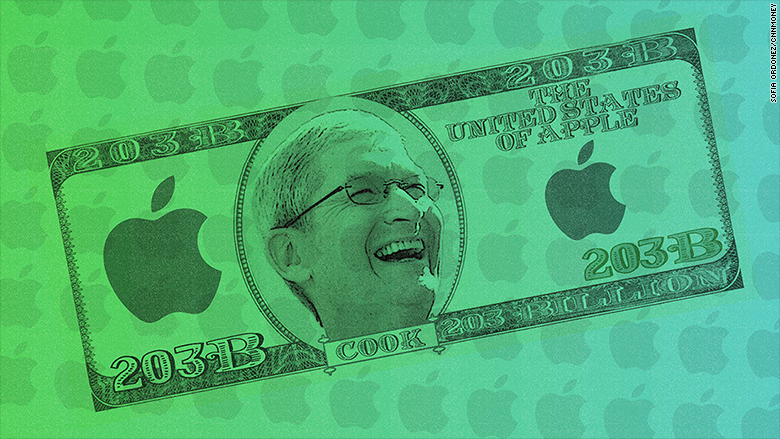
Source CNN Money
Previously, Apple and other technology firms have been able to control their message with Public Relations and publicity campaigns. That is why the EU announcement was like sour grapes to the Cupertino folk. Apple and Steve Jobs have been superb at using their events to sell hyper-personalized devices into the networked gee-wiz economy, flogging consumers the story that human value and virtue is tied to the private ownership of an Apple product. Millions of people accepted the narrative and bought Apple products, which for the most part, worked well.
Plus, they were none-too-subtly presented as luxury and social status items, with an expensive price point. (I use an Android because I could not abide the proprietary aspect of Apple iTunes and music libraries, which originally forced me to use Apple products on ipods). New entrants into the global economy, especially consumers in China, are new user-markets, and often, along with manipulable consumers everywhere, status seekers, for whom and iPhone signifies ascension into the middle class... of something. (More research on this please).
Apple CEO Tim Cook summarized the Chinese market:
It is worth noting that the US financial press tend to agree with Apple's strategy of keeping its profits in cash offshore, rather than repatriating it to the US to be taxed and invested. (How about investing in depressed parts of the South, the rust belt areas of the north east, and in education and training?)
Meanwhile, the Irish Government's technology sector has put up some impressive numbers for technology investments. For examples in 2014, Ireland's Direct Investment Agency noted the following inward movements of announced investments:
Governments and corporations seek to control the narrative around the shift to high quality technology sector jobs. (I was once employed doing pretty much that in helping to establish Multimedia Victoria (Australia) in 1994-1996.)
In this context, Apple controlled the narrative, the inflated price for their products and a massive pipeline of profit. Then came the EC and several other public policy institutions, including the G20, suggesting another perspective on the Apple success story. Indeed, at its Brisbane, Australia 2014 meeting, the G20 issued the following (on 15 November):
Finally, 31 August 2016, the New York Times headline, one among many, pointed to the wind change: The-tax-man-comes-for-apple-in-Ireland.
The first response by Apple was predictable: A massive defense of its agreement with the Irish Government, promoting the thought that this is the pointy end of corporate America, and why senior executives earn their inordinate salaries:
Apple CEO Tim Cook collects his paycheck! The Irish Government joined in, although as RT reported, rejecting a payout of about 14 Billion from Apple! There is nothing quite as undignified as hearing politicians explain why the public should be worse off.
The response from the US government varied somewhat depending on the media outlet reporting it. The Wall Street Journal opted for "the EC is bad" subtext, in a commonplace US trope of making an enemy of anything that disagrees with it. (As a former rugby player, I think Americans would gain much from not only the rugby habit of shaking hands with opponents after a game then going to have a beer.) Active Telecoms at least covered the story from a distance. Although like The Guardian, it noted the abrasive tone coming from Treasury Secretary Jack Lew, who came up with the "supranational tax authority" criticism of the EC.
Apparently it is all right for US companies like Apple to be supranational, but not for the governing body for the EU to insist on its rule of law, when one of its member nations (Ireland) engages in State Aid (to Apple).
The ethics of all this is engaging, deserving much more public discussion.
More importantly, finding a way to critically engage with the behavior of Apple and the Irish Government offers a way to think through what the Australian academic Phillip Anthony O’Hara referred to as "The Corruption Industry."
Writing in the Journal of Economic Issues June 2014, O'Hara's article "Political Economy of Systemic and Micro-Corruption Throughout the World," made the point that corruption's long history incorporates the following:
The answer to the question in the title, does Apple Ireland epitomize "The Corruption Industry" is clearly Yes.
The EC should be congratulated for taking action in attempting to put a stop to a corrupt system of tax avoidance and financial organization. It should be encouraged to pursue the public interest and civil society, against the private and privatizing interests of corrupt and corrupting individuals, governments and corporations.
The headline to the EC's Press Release read
State aid: Ireland gave illegal tax benefits to Apple worth up to €13 billion
Under a scheme that wobbled around in the public shadows since it was introduced in 1991, the agreement between Apple and the Irish Government served two principle purposes:
It reduced Apple's tax bill
and
It brought technology jobs to Ireland.
From a public policy perspective is achieved one major outcome:
- It helped to impoverish the Irish population relative to what might have been achieved.
The Irish people be damned.
Meanwhile, the Chinese people making the products, could also be damned. We know this from published research about Foxconn. As if to add insult to injury, Foxconn announced in May 2016 that it is resolving its human resources issue by replacing 60,000 employees with robots. And thus the Apple machine rolls on.
The EC tax news was welcomed by critics of the the contemporary global corporate system operating under neo-liberalism. The EU move sharply brought to the surface of public debate the way neo-liberalism had been structurally imbricated into everyday life through agreements between global corporations and national governments. The public has little knowledge of how they are made or why. Challenging these agreements has escalated, despite the appeal of the very devices - primarily iPhones - that make Apple a success. It is somewhat like an ugly fruit that tastes good: the eater rejects the object, yet enjoys the experience.
Clearly, the terrific personal and social benefits arising from the use of smart phones come at a cost. In this case, the cost of being a subservient nation relying on the decisions of a corporation to outsource parts of its financial interests.
Source CNN Money
Previously, Apple and other technology firms have been able to control their message with Public Relations and publicity campaigns. That is why the EU announcement was like sour grapes to the Cupertino folk. Apple and Steve Jobs have been superb at using their events to sell hyper-personalized devices into the networked gee-wiz economy, flogging consumers the story that human value and virtue is tied to the private ownership of an Apple product. Millions of people accepted the narrative and bought Apple products, which for the most part, worked well.
Plus, they were none-too-subtly presented as luxury and social status items, with an expensive price point. (I use an Android because I could not abide the proprietary aspect of Apple iTunes and music libraries, which originally forced me to use Apple products on ipods). New entrants into the global economy, especially consumers in China, are new user-markets, and often, along with manipulable consumers everywhere, status seekers, for whom and iPhone signifies ascension into the middle class... of something. (More research on this please).
Apple CEO Tim Cook summarized the Chinese market:
I've never seen as many people coming into the middle class as they are in China," ... "That's where the bulk of our sales are going. We're really proud of the results there and we are continuing to invest in the country.In 2015 iPhone sales in China surpassed sales numbers in the US. But the real story is the estimated $200 billion held offshore (the USA) by Apple.
It is worth noting that the US financial press tend to agree with Apple's strategy of keeping its profits in cash offshore, rather than repatriating it to the US to be taxed and invested. (How about investing in depressed parts of the South, the rust belt areas of the north east, and in education and training?)
Meanwhile, the Irish Government's technology sector has put up some impressive numbers for technology investments. For examples in 2014, Ireland's Direct Investment Agency noted the following inward movements of announced investments:
- Intel’s recent $5 billion spend at its Irish fab.
- Microsoft’s €170 million data centre expansion, bringing its total investment to €594 million.
- Ericsson: 120 additional R&D positions.
- SAP: 260 new roles (R&D/technology support).
- PayPal: 400 new positions (including customer solutions/telesales).
Governments and corporations seek to control the narrative around the shift to high quality technology sector jobs. (I was once employed doing pretty much that in helping to establish Multimedia Victoria (Australia) in 1994-1996.)
In this context, Apple controlled the narrative, the inflated price for their products and a massive pipeline of profit. Then came the EC and several other public policy institutions, including the G20, suggesting another perspective on the Apple success story. Indeed, at its Brisbane, Australia 2014 meeting, the G20 issued the following (on 15 November):
13. We are taking actions to ensure the fairness of the international tax system and to secure countries’ revenue bases. Profits should be taxed where economic activities deriving the profits are performed and where value is created. We welcome the significant progress on the G20/OECD Base Erosion and Profit Shifting (BEPS) Action Plan to modernise international tax rules.
The EC launched an inquiry into "transfer pricing" in 2014. It is too obvious to point out that once the interests of major global institutions like the G20, the OECD and EC converge, significant progress towards democratic polity can result? The history of political economy would suggest that coordinated public policy interest serves as a major prompt for reform. Although it is usually too little too late.
Finally, 31 August 2016, the New York Times headline, one among many, pointed to the wind change: The-tax-man-comes-for-apple-in-Ireland.
The first response by Apple was predictable: A massive defense of its agreement with the Irish Government, promoting the thought that this is the pointy end of corporate America, and why senior executives earn their inordinate salaries:
Apple CEO Tim Cook collects his paycheck! The Irish Government joined in, although as RT reported, rejecting a payout of about 14 Billion from Apple! There is nothing quite as undignified as hearing politicians explain why the public should be worse off.
The response from the US government varied somewhat depending on the media outlet reporting it. The Wall Street Journal opted for "the EC is bad" subtext, in a commonplace US trope of making an enemy of anything that disagrees with it. (As a former rugby player, I think Americans would gain much from not only the rugby habit of shaking hands with opponents after a game then going to have a beer.) Active Telecoms at least covered the story from a distance. Although like The Guardian, it noted the abrasive tone coming from Treasury Secretary Jack Lew, who came up with the "supranational tax authority" criticism of the EC.
Apparently it is all right for US companies like Apple to be supranational, but not for the governing body for the EU to insist on its rule of law, when one of its member nations (Ireland) engages in State Aid (to Apple).
The ethics of all this is engaging, deserving much more public discussion.
More importantly, finding a way to critically engage with the behavior of Apple and the Irish Government offers a way to think through what the Australian academic Phillip Anthony O’Hara referred to as "The Corruption Industry."
Writing in the Journal of Economic Issues June 2014, O'Hara's article "Political Economy of Systemic and Micro-Corruption Throughout the World," made the point that corruption's long history incorporates the following:
...the promotion of vested interests against the common good in the form of bribery, fraud, embezzlement, state capture, nepotism, extortion and others.In many respects, the neo-liberal financial structure that made it possible for Apple and Ireland to make arrangements are an extension of this set of corrupt practices. In effect, Apple-Ireland serves as a case study for this method of interaction, in a political economy model that normalizes a kind of corporatized agency operating outside of and against the public interest.
The answer to the question in the title, does Apple Ireland epitomize "The Corruption Industry" is clearly Yes.
The EC should be congratulated for taking action in attempting to put a stop to a corrupt system of tax avoidance and financial organization. It should be encouraged to pursue the public interest and civil society, against the private and privatizing interests of corrupt and corrupting individuals, governments and corporations.
Wednesday, July 6, 2016
Rupert Murdoch is at it again - after Brexit in the UK
As the UK ponders next steps about removing itself from the European Union it is becoming clear that the News Corporation, News International "newspapers" owned by Rupert Murdoch have had an important role in influencing public opinion.
Of course, it is not the newspapers and their journalistic editorial staff, but the owner who seeks to influence public opinion in favor of his preferred outcomes. Mr Murdoch has a strong record of being an interventionist owner, of using his newpapers and since 1996, Fox News, his cable television channel, to influence politics in the UK, the US and Australia.
Media and journalism scholars in the liberal tradition have argued that this is a morally repugnant abuse of ownership rights. That argument hardly holds up. Liberals embody a fantasy of objectivity in journalism, all the while steering clear of major social issues deemed of little interest to their readership.
One example is the rise of the one percent, who have flourished due to tax laws that help them avoid contributing to the public interest and society, except through self-serving charities and philanthropy, on which they decide. Few media outlets challenge the importance of sustaining a progressive taxation base that redistributes wealth across the citizenry. Instead, greed and self-interest are considered inherently righteous. (The end of this default position in the US emerged with the rise of Bernie Sanders, who made economic justice a hallmark of his campaign).
Rupert Murdoch's media empire has contributed to this consolidation of unfairness and injustice around the world. He has no shame in promoting politicians and political parties that promote this ideology.
It is worth noting that Mr Murdoch has been an active protagonist for conservative causes for years, since he set about disabling the journalism unions in the UK during Margaret Thatcher's time as Prime Minister in the 1980s. Before that he set about undoing the Australian Labor Party Government of Prime Minister Gough Whitlam in Australian in 1975, a party whose election his national newspaper The Australian, had previously supported.
Mr Murdoch's hand can be seen in his influence on two major British newspapers, The Times and The Sun. According to Roy Greenslade, writing in The Guardian on July 6, their editorials in favor of a new Tory leader showed disturbing uniformity in support of one candidate. In reaching his conclusion, Greensland asks:
The answers are probably obvious.
However, what caught my eye was a statement in the Comments section of the same Guardian article. (This section, indeed the entire Guardian enterprise, has been heavily criticized of late for cutting and editing comments and for its support of anemic Labour Party policies, promoting the launch of Off-Guardian... but that is another story.)
As Joseph Reagle noted in his recent MIT book, Reading the Comments: Likers, Haters and Manipulators of the Web, much media commentary says a lot about how some members of the public feel about pressing issues. In this "trollplex," writers looking for an opportunity to "vent" their prejudices as trolls say anything, mostly hurtful, generally destructive and in line with the increasing barbarity of the times.
Jacob Weisberg noted in "Are we hopelessly hooked?" his comments about of the book in The New York Review of Books (February 25, 2016): "It's a world devoid of empathy."
The Guardian comment that captured my attention came from an Anonymous contributor named:
This is a terrific piece of evidence. I wish the author would reveal him or herself, to authenticate the quote. It helpfully consolidates the criticism of Murdoch's attitude to his ownership rights to interference, not to mention the value of the European Union as a force that is less beholden to petty national concerns and the selfish interests of individuals. (This does not appear to apply to the influence of German and French financial institutions in the EU).
Much more could be said about this matter, especially the important task of finding politicians and political parties who can work out how to resist and deny Mr Murdoch's unhealthy influence. For the time being that appears unlikely.
Of course, it is not the newspapers and their journalistic editorial staff, but the owner who seeks to influence public opinion in favor of his preferred outcomes. Mr Murdoch has a strong record of being an interventionist owner, of using his newpapers and since 1996, Fox News, his cable television channel, to influence politics in the UK, the US and Australia.
Media and journalism scholars in the liberal tradition have argued that this is a morally repugnant abuse of ownership rights. That argument hardly holds up. Liberals embody a fantasy of objectivity in journalism, all the while steering clear of major social issues deemed of little interest to their readership.
One example is the rise of the one percent, who have flourished due to tax laws that help them avoid contributing to the public interest and society, except through self-serving charities and philanthropy, on which they decide. Few media outlets challenge the importance of sustaining a progressive taxation base that redistributes wealth across the citizenry. Instead, greed and self-interest are considered inherently righteous. (The end of this default position in the US emerged with the rise of Bernie Sanders, who made economic justice a hallmark of his campaign).
Rupert Murdoch's media empire has contributed to this consolidation of unfairness and injustice around the world. He has no shame in promoting politicians and political parties that promote this ideology.
It is worth noting that Mr Murdoch has been an active protagonist for conservative causes for years, since he set about disabling the journalism unions in the UK during Margaret Thatcher's time as Prime Minister in the 1980s. Before that he set about undoing the Australian Labor Party Government of Prime Minister Gough Whitlam in Australian in 1975, a party whose election his national newspaper The Australian, had previously supported.
Mr Murdoch's hand can be seen in his influence on two major British newspapers, The Times and The Sun. According to Roy Greenslade, writing in The Guardian on July 6, their editorials in favor of a new Tory leader showed disturbing uniformity in support of one candidate. In reaching his conclusion, Greensland asks:
Am I being overly conspiracist in detecting Rupert Murdoch pulling strings at his two newspapers? Or is it mere coincidence that Times editor John Witherow and Sun editor Tony Gallagher reached the same opinion, and used the same phrases, to fight the good fight on behalf of Gove?
The answers are probably obvious.
However, what caught my eye was a statement in the Comments section of the same Guardian article. (This section, indeed the entire Guardian enterprise, has been heavily criticized of late for cutting and editing comments and for its support of anemic Labour Party policies, promoting the launch of Off-Guardian... but that is another story.)
As Joseph Reagle noted in his recent MIT book, Reading the Comments: Likers, Haters and Manipulators of the Web, much media commentary says a lot about how some members of the public feel about pressing issues. In this "trollplex," writers looking for an opportunity to "vent" their prejudices as trolls say anything, mostly hurtful, generally destructive and in line with the increasing barbarity of the times.
Jacob Weisberg noted in "Are we hopelessly hooked?" his comments about of the book in The New York Review of Books (February 25, 2016): "It's a world devoid of empathy."
The Guardian comment that captured my attention came from an Anonymous contributor named:
sdetop
I once asked Rupert Murdoch why he was so opposed to the European Union.
'That’s easy,' he replied. 'When I go into Downing Street they do what I say; when I go to Brussels they take no notice.'
This is a terrific piece of evidence. I wish the author would reveal him or herself, to authenticate the quote. It helpfully consolidates the criticism of Murdoch's attitude to his ownership rights to interference, not to mention the value of the European Union as a force that is less beholden to petty national concerns and the selfish interests of individuals. (This does not appear to apply to the influence of German and French financial institutions in the EU).
Much more could be said about this matter, especially the important task of finding politicians and political parties who can work out how to resist and deny Mr Murdoch's unhealthy influence. For the time being that appears unlikely.
Tuesday, June 14, 2016
What is a "self-radicalized individual?" The Internet has changed the culture
A number of people have pointed to the tragedy of the mass shooting in the Pulse nightclub in Orlando Florida on Sunday June 12, as an event defined by the grey area between a hate crime and the work of Islamist extremism.
Unfortunately, as George Washington Criminologist Fredrick Lemieux pointed out in an article about US mass shootings, there is a relationship between the number of guns in circulation and mass shootings. The conflation of hate with Islamist extremism is barely relevant when so many guns are in circulation.
For media and cultural studies scholars, are there more powerful questions to ask about the relationship between the Internet and hate-extremist acts? This would not only include acts of vicious violence, but the entire panoply of mediated interactions.
The major point of entry for this inquiry is the research by Gerbner and Gross that influenced effects theory then cultivation theory which I used in Uprising (pp.180-181) to discus the Internet and jihad. The relationship between television violence and the cultivation of violence generally can be applied to the Internet and individual behavior. There is some academic literature on this, little of which has had any influence on public policy in the US. Nevertheless, we must persist, seeing violence in its relation to television as part of a historical sets of shifts from public care to private and individual self-interest.
The issue now is to understand what the phrase "self-radicalized individual" means. It is a phrase used by President Obama in seeking to explain what happened in the Orlando nightclub shooting. In Remarks by Obama after Orlando Shooting the President reached for the phrase. Then he left it hanging. Surely, when he referred to "self-radicalized individuals in this country," he immediately gave the Internet more salience.
In the follow up, some of the media focus has pinpointed the role of the Internet, even down to a video excerpt that excluded other comments about the National Rifle Association and gun violence. Such coverage privileges the Internet, offering a hinted cause without a reason.
President Obama made the following comment:
...that one of the biggest challenges we are going to have is this kind of propaganda and perversions of Islam that you see generated on the Internet, and the capacity for that to seep into the minds of troubled individuals or weak individuals, and seeing them motivated then to take actions against people here in the United States and elsewhere in the world that are tragic.
From the ISIS perspective, the idea of terror is effective when it is translated into any action, even an action taken by an individual that names ISIS. This marks a shift in the culture that should interest media and cultural studies analysis.
A discussion about the change in culture as a result of technology was recently noted by Edward Mendelson in a review of several books in The Depths of the Internet Age. He points to the shifts in culture traced to technology. This is no surprise. But as I have been saying for years, it is clear that we have to make a connection between Internet technologies and media and the assumptions of liberal democracy. In fact, liberal democracy as it is known is coming to an end as the Internet establishes new social and economic relations.
It is pointless to refer to "self-radicalized individuals" then pretend that there is not a cause and effect between the Internet and jihad violence.
This technological determinism defines the complexity of contemporary society, including the end of the culture as we know it. Individuals act in their relation to the Internet not in relation to the physical presence of others. The spectacle of the Pulse shootings can be seen as the expression of an individual performing his radicalized self. It is an act determined by the digital information flow of narrowed down options that makes it commonplace to think of others as wrong, evil and worthy of annihilation.
In some ways the "self radicalized individual" could be seen as the ideal type - the perfect counter-intuitive extension of all that the Internet could achieve. As Judith Butler might put it in Notes Toward a Performative Theory of Assembly (2015) our interdependence as human beings has being made more precarious as the old political forms of assembly are disassembled.
The Internet has empowered the individual against society, against public assembly in more intense relations with other individuals. The result is that everyone in the US feels more isolated, more precarious and nothing President Obama says helps.
Unfortunately, as George Washington Criminologist Fredrick Lemieux pointed out in an article about US mass shootings, there is a relationship between the number of guns in circulation and mass shootings. The conflation of hate with Islamist extremism is barely relevant when so many guns are in circulation.
For media and cultural studies scholars, are there more powerful questions to ask about the relationship between the Internet and hate-extremist acts? This would not only include acts of vicious violence, but the entire panoply of mediated interactions.
The major point of entry for this inquiry is the research by Gerbner and Gross that influenced effects theory then cultivation theory which I used in Uprising (pp.180-181) to discus the Internet and jihad. The relationship between television violence and the cultivation of violence generally can be applied to the Internet and individual behavior. There is some academic literature on this, little of which has had any influence on public policy in the US. Nevertheless, we must persist, seeing violence in its relation to television as part of a historical sets of shifts from public care to private and individual self-interest.
The issue now is to understand what the phrase "self-radicalized individual" means. It is a phrase used by President Obama in seeking to explain what happened in the Orlando nightclub shooting. In Remarks by Obama after Orlando Shooting the President reached for the phrase. Then he left it hanging. Surely, when he referred to "self-radicalized individuals in this country," he immediately gave the Internet more salience.
In the follow up, some of the media focus has pinpointed the role of the Internet, even down to a video excerpt that excluded other comments about the National Rifle Association and gun violence. Such coverage privileges the Internet, offering a hinted cause without a reason.
President Obama made the following comment:
The one thing that we can say is that this is being treated as a terrorist investigation. It appears that the shooter was inspired by various extremist information that was disseminated over the Internet. All those materials are currently being searched, exploited so we will have a better sense of the pathway that the killer took in making the decision to launch this attack.President Obama also said:
As far as we can tell right now, this is certainly an example of the kind of homegrown extremism that all of us have been so concerned about for a very long time.Changes in attitude are underway.
...that one of the biggest challenges we are going to have is this kind of propaganda and perversions of Islam that you see generated on the Internet, and the capacity for that to seep into the minds of troubled individuals or weak individuals, and seeing them motivated then to take actions against people here in the United States and elsewhere in the world that are tragic.
From the ISIS perspective, the idea of terror is effective when it is translated into any action, even an action taken by an individual that names ISIS. This marks a shift in the culture that should interest media and cultural studies analysis.
A discussion about the change in culture as a result of technology was recently noted by Edward Mendelson in a review of several books in The Depths of the Internet Age. He points to the shifts in culture traced to technology. This is no surprise. But as I have been saying for years, it is clear that we have to make a connection between Internet technologies and media and the assumptions of liberal democracy. In fact, liberal democracy as it is known is coming to an end as the Internet establishes new social and economic relations.
It is pointless to refer to "self-radicalized individuals" then pretend that there is not a cause and effect between the Internet and jihad violence.
This technological determinism defines the complexity of contemporary society, including the end of the culture as we know it. Individuals act in their relation to the Internet not in relation to the physical presence of others. The spectacle of the Pulse shootings can be seen as the expression of an individual performing his radicalized self. It is an act determined by the digital information flow of narrowed down options that makes it commonplace to think of others as wrong, evil and worthy of annihilation.
In some ways the "self radicalized individual" could be seen as the ideal type - the perfect counter-intuitive extension of all that the Internet could achieve. As Judith Butler might put it in Notes Toward a Performative Theory of Assembly (2015) our interdependence as human beings has being made more precarious as the old political forms of assembly are disassembled.
The Internet has empowered the individual against society, against public assembly in more intense relations with other individuals. The result is that everyone in the US feels more isolated, more precarious and nothing President Obama says helps.
Sunday, April 3, 2016
Saturday, March 19, 2016
‘Smog Jog’ Through Beijing, Zuckerberg is Ignored
The obsession with digital media applications is everywhere - well almost! Almost every moment of our contemporary lives is commonly consumed in and around screen space. Panic ensues, as the real, non-digital world disappears into the virtual. Hand wringing ensues, as images of civilization in decline appear. Unless you are one of several billion people who could not care less!

As this image from The New York Times of "The Zuck" and his colleagues shows, Mao-Tse-Tung is more interesting than a young American billionaire!
The New York Times did NOT draw attention to the crowds of Chinese presumably listening to stories about the Great Helmsman as they visited Tiananmin Square, their backs tuned to The Zuck. The Times article, sadly pre-occupied with all things American, was about the implicit stupidity of Zuckerberg who went for a run in Beijing on a day when the air pollution was dangerously high.
This is a kind of metaphor for the digital revolution. Power on 'bro, and insist on doing whatever you were doing, regardless of the risk to personal health, the social impact on people regardless of their circumstances or the alignment of national public interests with private preoccupations.
To reiterate this point of criticism, all things digital are overpowering non-virtual everyday life in the west with a view to universalize the digital.
Social Media has produced then reproduced the one per cent in their celebrity bearing and new-found wealth. These new Gilded gurus are the cause of all sorts of envy. They are apparently brilliant and so on.
I can hardly bother trying to find the words to describe their unchallenged dominance at the pointy end of the triangle of wealth and power at which they reside, not to mention the volumes of uncritical journalism, Public Relations, Marketing and Advertising circulating around them. Nor can I expend much energy on the thousands of wanna-be innovators, the Business School courses operating within a non-humanistic, uncritical perspective, dedicated to making more profit, wealth and whatever else the dream is made of this time around.
On the other hand, thank you to Google for contributing $500,000 to Patrice Cullors, one of the founders of Black Lives Matter, to "further develop a program to help Californian residents monitor and respond to acts of police violence," as Jelani Cobb reported in the March 14, 2016 edition of The New Yorker magazine. See The Matter of Black Lives
Imagine if Google gave all its money to social programs and economic development?
If The Zuck's application and business focused on fighting racism, poverty and social despair, the Chinese visiting Tianamin Square may have noticed him ... For now he is irrelevant to them.
It is worth remembering the great achievements of Chinese society, following Mao Tse Tung's successful overthrow of feudal interests and foreign powers in 1949.
I hope that the Chinese continue their development in such a way that The Zuck and those like him who spend time focused on Social Media, will remain or become irrelevant to the Chinese. This is unlikely, but worth the effort, in order to build a multipolar, differentiated planet. And hopefully find the place where smog is not an issue!
Facebook founder Mark Zuckerberg would probably be delighted to have the entire planet connect to his Social Media Application. One should also assume that the US Government shares this enthusiasm for all things socially-defined by a young American. Thankfully, this is not the case.

As this image from The New York Times of "The Zuck" and his colleagues shows, Mao-Tse-Tung is more interesting than a young American billionaire!
The New York Times did NOT draw attention to the crowds of Chinese presumably listening to stories about the Great Helmsman as they visited Tiananmin Square, their backs tuned to The Zuck. The Times article, sadly pre-occupied with all things American, was about the implicit stupidity of Zuckerberg who went for a run in Beijing on a day when the air pollution was dangerously high.
This is a kind of metaphor for the digital revolution. Power on 'bro, and insist on doing whatever you were doing, regardless of the risk to personal health, the social impact on people regardless of their circumstances or the alignment of national public interests with private preoccupations.
To reiterate this point of criticism, all things digital are overpowering non-virtual everyday life in the west with a view to universalize the digital.
Social Media has produced then reproduced the one per cent in their celebrity bearing and new-found wealth. These new Gilded gurus are the cause of all sorts of envy. They are apparently brilliant and so on.
I can hardly bother trying to find the words to describe their unchallenged dominance at the pointy end of the triangle of wealth and power at which they reside, not to mention the volumes of uncritical journalism, Public Relations, Marketing and Advertising circulating around them. Nor can I expend much energy on the thousands of wanna-be innovators, the Business School courses operating within a non-humanistic, uncritical perspective, dedicated to making more profit, wealth and whatever else the dream is made of this time around.
On the other hand, thank you to Google for contributing $500,000 to Patrice Cullors, one of the founders of Black Lives Matter, to "further develop a program to help Californian residents monitor and respond to acts of police violence," as Jelani Cobb reported in the March 14, 2016 edition of The New Yorker magazine. See The Matter of Black Lives
Imagine if Google gave all its money to social programs and economic development?
If The Zuck's application and business focused on fighting racism, poverty and social despair, the Chinese visiting Tianamin Square may have noticed him ... For now he is irrelevant to them.
It is worth remembering the great achievements of Chinese society, following Mao Tse Tung's successful overthrow of feudal interests and foreign powers in 1949.
I hope that the Chinese continue their development in such a way that The Zuck and those like him who spend time focused on Social Media, will remain or become irrelevant to the Chinese. This is unlikely, but worth the effort, in order to build a multipolar, differentiated planet. And hopefully find the place where smog is not an issue!
Tuesday, January 19, 2016
Virtual tales, Western fantasies vs Fundamentalism
Visiting Washington D.C., Australian Prime Minister Malcolm Turnbull adopted a very Australian idea for reducing the influence of ISIS on line. The suggested solution? Contradict, mock and disprove their ideology.
It is hard to take this analysis seriously. Presumably, this Comedy Central approach will take off in cyberspace, when ISIS fighters have some down time. Ridiculous.
The opponents of ISIS believe that rationality informs ISIS and its fighters and that a solution can be found in appealing to that rationality. Such rationality is based on western bourgeois notions of liberalism. It is blind to the way religious belief operates when it becomes fanatical. In other words it is blind to the contradictions: the Islamic faith is highly rational, until like all religions, it moves into the mystical realm, then it is no longer rational.
As I have argued previously, the combination of religious belief and the Internet offers ideal conditions under which irrationality can operate. The countervailing forces (to quote John Kenneth Galbraith in another context) on which liberalism relies for its survival, are evacuated within fundamentalist belief, then reified (made concrete) through the Internet. Fundamentalism removes every obstacle to singular belief and action. ISIS and the Islamic State are the result of this unsurpassed alchemy.
A rational program of belief gives way to the mysticism of belief.
The central contradiction of the Internet - social media or any virtual tool - is its ability to take and make a belief system so completely that no questions can be asked. This is nothing new. It is "ideological grooming." This idea, discussed in Uprising and in previous blogs, does not receive adequate discussion because it may be too close to home for some promoters of Internet applications. There is a blind spot among many people, in their inability to reflect on the way ideology is constructed by the Internet.
The French academic Armand Mattelart in his 2001 book Information Society makes the point that there is "A new ideology that dare not speak its name..."(2). This idea needs much more consideration, not just in light of the way ISIS uses the Internet.
Meanwhile, Turnbull made some helpfully nuanced comments about ISIS which suggest that the challenges of addressing a fundamentalist minority within the larger streams of Islam will require more detailed analysis.
Isil may have an archaic and barbaric ideology, but its use of technology and social media, in particular, is very sophisticated... As Isil uses social media for its propaganda, we must respond rapidly and persuasively with the facts. It was clear to me from my recent visit, that the Iraqi government and other anti-Isil forces are not reacting quickly enough to contradict Isil’s online messages, which have been used both to recruit new fighters and demoralise those who oppose them and we should help them with this. Isil claims must be mocked and disproved as soon as they are made ... the cyber sphere demands reactions as rapid as the kinetic battlefield.
It is hard to take this analysis seriously. Presumably, this Comedy Central approach will take off in cyberspace, when ISIS fighters have some down time. Ridiculous.
The opponents of ISIS believe that rationality informs ISIS and its fighters and that a solution can be found in appealing to that rationality. Such rationality is based on western bourgeois notions of liberalism. It is blind to the way religious belief operates when it becomes fanatical. In other words it is blind to the contradictions: the Islamic faith is highly rational, until like all religions, it moves into the mystical realm, then it is no longer rational.
As I have argued previously, the combination of religious belief and the Internet offers ideal conditions under which irrationality can operate. The countervailing forces (to quote John Kenneth Galbraith in another context) on which liberalism relies for its survival, are evacuated within fundamentalist belief, then reified (made concrete) through the Internet. Fundamentalism removes every obstacle to singular belief and action. ISIS and the Islamic State are the result of this unsurpassed alchemy.
A rational program of belief gives way to the mysticism of belief.
The central contradiction of the Internet - social media or any virtual tool - is its ability to take and make a belief system so completely that no questions can be asked. This is nothing new. It is "ideological grooming." This idea, discussed in Uprising and in previous blogs, does not receive adequate discussion because it may be too close to home for some promoters of Internet applications. There is a blind spot among many people, in their inability to reflect on the way ideology is constructed by the Internet.
The French academic Armand Mattelart in his 2001 book Information Society makes the point that there is "A new ideology that dare not speak its name..."(2). This idea needs much more consideration, not just in light of the way ISIS uses the Internet.
Meanwhile, Turnbull made some helpfully nuanced comments about ISIS which suggest that the challenges of addressing a fundamentalist minority within the larger streams of Islam will require more detailed analysis.
We should not be so delicate as to say Isil and its ilk have ‘got nothing to do with Islam’. But equally we should not tag all Muslims or their religion with responsibility for the crimes of a tiny criminal minority. That is precisely what the extremists want us to doHe immediately gets this wrong as well. Fundamentalists are not criminals. They are singular believers with a utopian ideal that is fully realized in three layers:
- the religious experience
- virtual remediation
- the eternal.
This mix makes a Comedy Central solution pointless. It requires deliberation on how to address ideology in the context of religion and in relation to ISIS, in the context of the history of the Middle East.
Subscribe to:
Posts (Atom)